What leverage is
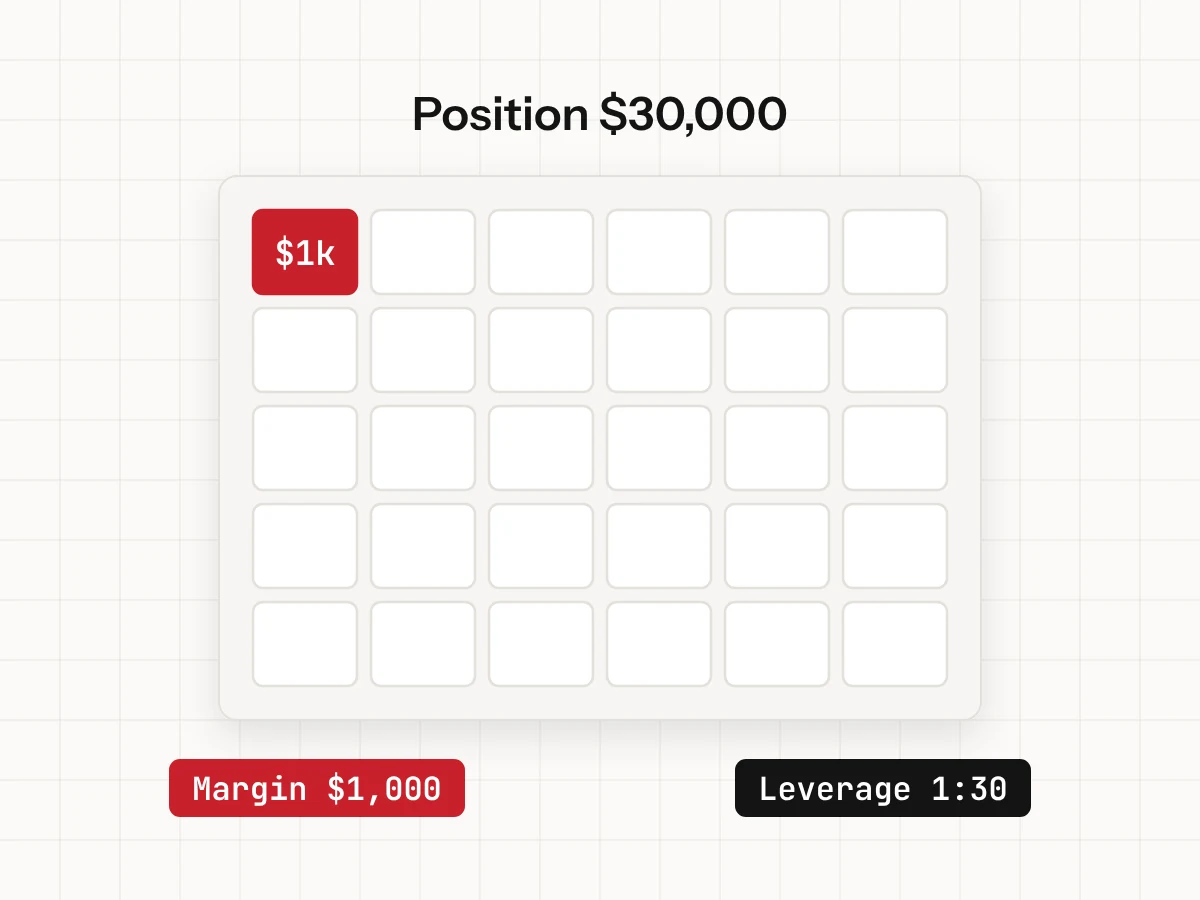
Leverage is the ratio between the size of a position and the deposit needed to open it. At 1:30, every $1 of deposit controls $30 of position. The deposit is called margin. It is not a fee: it is set aside while the trade is open and released when you close it, with your profit or loss added or taken away.
- 1:30 means a margin of 1 ÷ 30 = 3.33% of the position value
- 1:100 means 1 ÷ 100 = 1%
- 1:500 means 1 ÷ 500 = 0.2%
The leverage available depends on the broker, the account type, the asset class and often local rules. Check it in your account details and in each market’s contract specification. If pips and lots are new to you, start with Trading basics for beginners.
How to calculate margin
Margin takes two steps: position value = lots × contract size × price, then margin = position value ÷ leverage.
One standard lot of EUR/USD at 1.08450 is worth 1 × 100,000 × 1.08450 = $108,450. At 1:30 the margin is $108,450 ÷ 30 = $3,615.00. At 1:100 it is $108,450 ÷ 100 = $1,084.50. At 1:500 it is $108,450 ÷ 500 = $216.90. For 0.1 lots, divide each figure by 10: $361.50, $108.45 and $21.69.
When the base currency is your account currency, the price drops out of the first step. One lot of USD/JPY is $100,000 whatever the rate, so at 1:30 it needs $100,000 ÷ 30 = $3,333.33. For gold, indices and crypto, contract sizes differ between brokers, so take the contract size from the platform’s specification before you calculate.
Free margin, margin level, margin call and stop out
Four numbers tell you how much room your account has:
- Equity = balance + profit or loss on open positions
- Used margin = the margin held for all open positions
- Free margin = equity − used margin, the amount left for new trades and for absorbing losses
- Margin level = equity ÷ used margin × 100%
When losses push the margin level down to the broker’s margin call level, you get a warning and may not be able to open new positions. If it falls further to the stop out level, the platform starts closing positions automatically to limit further losses. Each broker sets its own levels and its own rules for which position closes first, so read your account terms. The levels below are only an example.
Say you have $2,000 and open 1 lot of EUR/USD at 1:100, using $1,084.50 of margin. Free margin is $2,000 − $1,084.50 = $915.50, and margin level is $2,000 ÷ $1,084.50 × 100% = about 184%. If the price moves 50 pips against you, equity drops to $1,500 and margin level to about 138%. After 100 pips, equity is $1,000 and margin level is about 92%, below a margin call level of, say, 100%. With a stop out at 50%, positions would be closed once equity fell to about $542, after a loss of about $1,458 from a move of about 146 pips. For simplicity, used margin is kept at $1,084.50 throughout.
In a fast market or over a weekend gap, positions can be closed at a worse price than the stop-out level suggests.
Why high leverage magnifies losses
Leverage does not change what a pip is worth. One lot of EUR/USD moves $10 per pip at 1:30 or at 1:500. What high leverage changes is how large a position you can open with the same money, and that is where the damage comes from.
You have $1,000. At 1:500, 4 lots of EUR/USD at 1.08450 need 4 × $216.90 = $867.60 of margin, so the account can open them. Each pip is now worth $40. A 25-pip move against you, a small move for EUR/USD, would cost 25 × $40 = $1,000, the whole account, and a stop out would close the position well before that. At 1:30, the same $1,000 can hold at most about 0.27 lots, where 25 pips costs about $68. A 25-pip move in your favor would gain the same amounts, which is why large positions are tempting. The loss side decides whether the account survives.
Use less leverage than you are offered
What counts is your effective leverage: the total value of your open positions divided by your equity. It shows how hard your account is actually working, whatever maximum the broker allows.
Your equity is $10,000 and you hold 0.5 lots of EUR/USD at 1.08450. The position is worth 0.5 × 100,000 × 1.08450 = $54,225, so your effective leverage is $54,225 ÷ $10,000 = about 5.4 times. That stays the same whether the account allows 1:30 or 1:500.
Ways to keep it low:
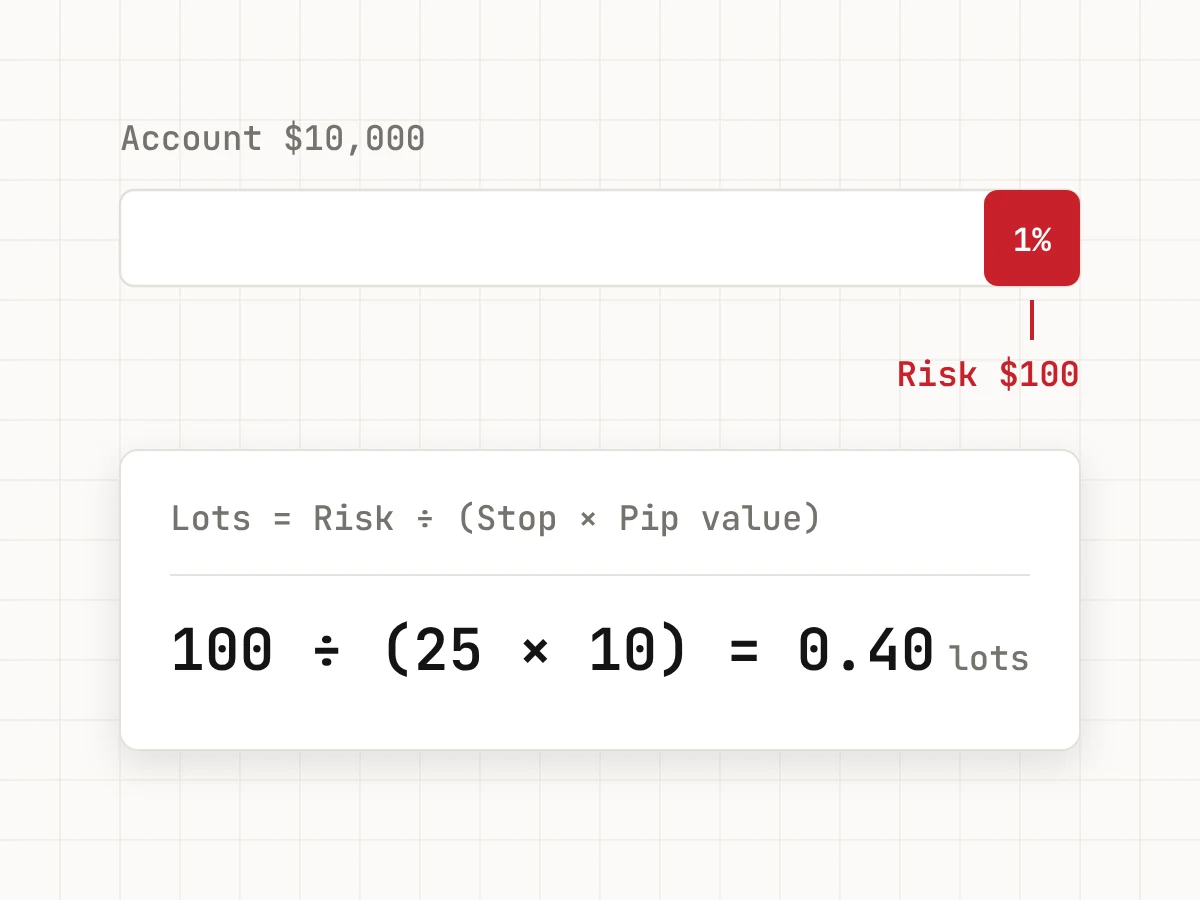
- Size each trade from your stop loss and a fixed risk, as shown in Managing risk and position size, not from the margin available.
- Set a personal cap on total effective leverage, for example 5 times your equity, and check it before adding a position.
- Keep the margin level far above your broker’s margin call level, so normal price swings cannot trigger it.
- If your broker lets you choose a lower account leverage, consider it. It limits how large a position you can open by mistake.
To practice without risking money, open a free demo account and work out the margin, free margin and effective leverage of each practice trade before you place it.
Before adding a new position, check your free margin and margin level. If one more trade would bring you close to the margin call level, the account is already carrying too much.
Key takeaways
- Margin = position value ÷ leverage. At 1:30 that is 3.33% of the position, at 1:100 it is 1%.
- Margin is a deposit, not a cost, but losses come out of your equity.
- Margin level = equity ÷ used margin × 100%. Brokers set their own margin call and stop out levels.
- Leverage does not change pip value. It changes how large a position you can open, and so how fast you can lose.
- Watch your effective leverage and keep it far below the maximum on offer.
This lesson is general education, not investment advice. Examples use illustrative numbers. CFDs are complex instruments and come with a high risk of losing money rapidly due to leverage.