Choose your risk per trade
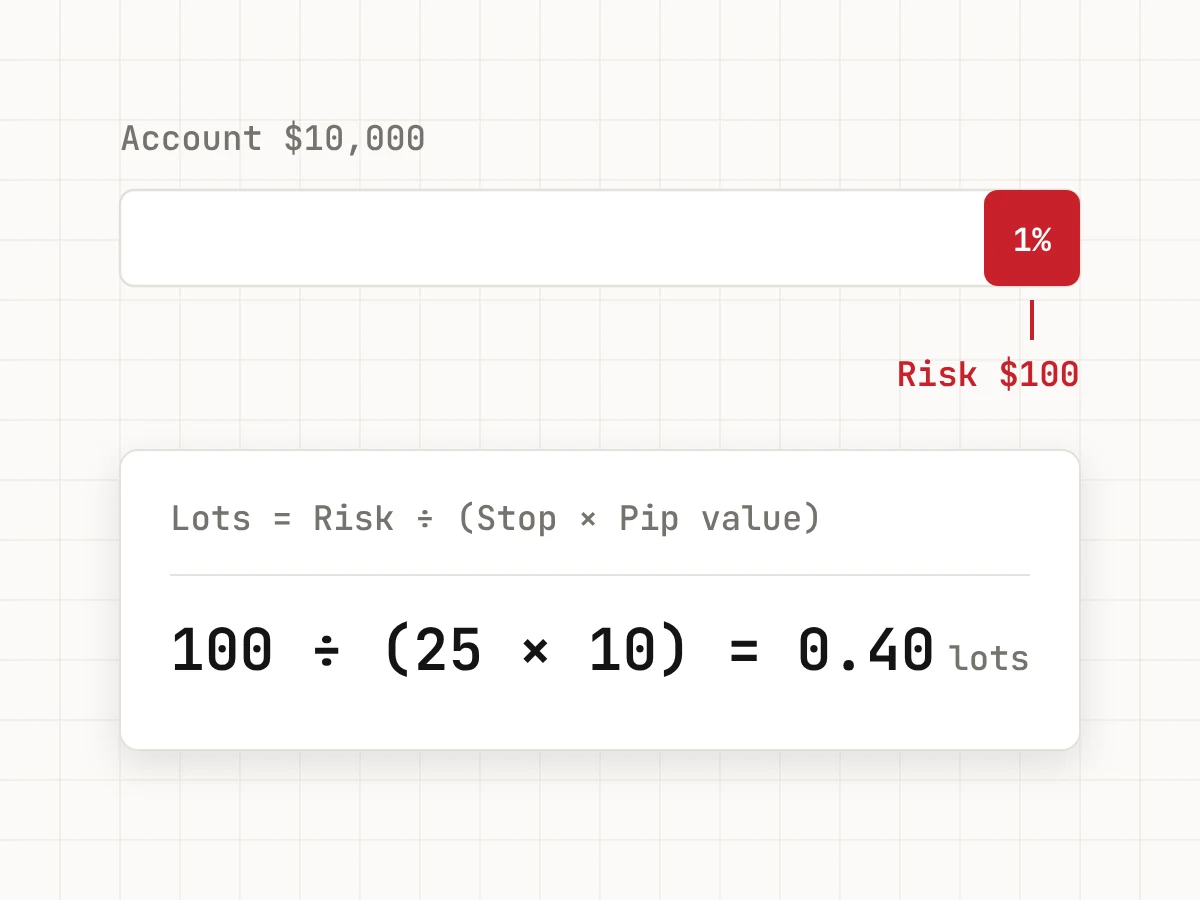
Start with one number: the most you will lose on a single trade, as a percentage of your account. Many traders use 1% to 2%, and 1% or less is a sensible place to start while you learn. On a $5,000 account, 1% is $50 and 2% is $100.
Risk means the amount you lose if your stop loss is hit. It is not the margin and not the position value. Work it out from your current equity before each trade, so the amount shrinks after losses and grows only as the account grows. The spread, slippage and price gaps can make the real loss slightly larger, so leave a little room for them.
Place the stop first, then the size
Put the stop loss where your trade idea is proven wrong, for example beyond a recent swing high or low and outside normal price noise. Do not move it closer just to allow a bigger position. Once the stop is set, the size follows from one formula:
Position size (lots) = money at risk ÷ (stop distance in pips × pip value per lot)
Round the result down to the lot step your platform allows, often 0.01, so you never risk more than planned. Using stop loss and take profit covers stop placement in more detail.
Worked example: EUR/USD
On pairs quoted in US dollars, such as EUR/USD, a pip is 0.0001 and is worth $10 per standard lot in a USD account.
Your account is $10,000 and you risk 1%, which is $100. You plan to buy EUR/USD at 1.08450 with a stop at 1.08150, a distance of 30 pips. Size = $100 ÷ (30 × $10) = $100 ÷ $300 = about 0.333 lots, rounded down to 0.33 lots. At 0.33 lots a pip is worth $3.30. If the stop is hit, you lose 30 × $3.30 = $99. If the price reaches a target at 1.09050, 60 pips away, you gain 60 × $3.30 = $198. Costs such as the spread come off either result.
If your analysis calls for a 60-pip stop instead, the size roughly halves: $100 ÷ (60 × $10) = about 0.167, rounded down to 0.16 lots, for a loss at the stop of 60 × $1.60 = $96. The dollar risk stays about the same; only the size changes.
Worked example: a JPY pair
On yen pairs a pip is 0.01, and its value is counted in yen first: 100,000 × 0.01 = ¥1,000 per standard lot. To convert it to US dollars, divide by the USD/JPY rate: pip value per standard lot = 100,000 × 0.01 ÷ USD/JPY rate.
USD/JPY is at 150.00, so one pip on a standard lot is worth ¥1,000 ÷ 150.00 = $6.67. Your account is $10,000 and you risk 1%, or $100. You plan to sell USD/JPY at 150.00 with a stop at 150.40, a distance of 40 pips. Size = $100 ÷ (40 × $6.67) = $100 ÷ $266.80 = about 0.375, rounded down to 0.37 lots. At 0.37 lots a pip is worth about 0.37 × $6.67 = $2.47, so the loss at the stop is about 40 × $2.47 = $98.80. A target at 149.20, 80 pips away, would gain about 80 × $2.47 = $197.60.
The pip value changes as USD/JPY moves: at 140.00 it is about $7.14 per standard lot, and at 160.00 it is $6.25. Use the current rate each time. The same ¥1,000 pip value applies to crosses such as EUR/JPY and GBP/JPY, converted at the USD/JPY rate, because their profit and loss is also counted in yen first.
Daily limits and losing streaks
Even with careful sizing, losses come in runs. With a 50% win rate, there is about an 80% chance of at least one streak of five or more losses in a row somewhere in 100 trades. Limits stop a bad day from becoming a bad month:
- A daily loss limit, for example stop trading for the day after losing 3% or after three losses in a row
- A weekly limit, for example 6%, after which you pause and review
- A cap on open risk, for example no more than 3% at risk across all open trades at once
Compare ten losses in a row on a $10,000 account, risking a fixed percentage of the current balance each time. At 1% per trade, each loss leaves 99% of the balance: $10,000 × 0.99¹⁰ = about $9,044, a drawdown of about 9.6%, and you need a gain of about 10.6% to get back to $10,000. At 5% per trade: $10,000 × 0.95¹⁰ = about $5,987, a drawdown of about 40%, and you need a gain of about 67% to recover.
Let the order ticket do the math
In SPM Trader’s order ticket you can enter your risk in the Risk (% equity) field together with your stop loss, and the platform calculates the lot size before you click. The stop loss and take profit can be set as a price, in pips or in dollars.
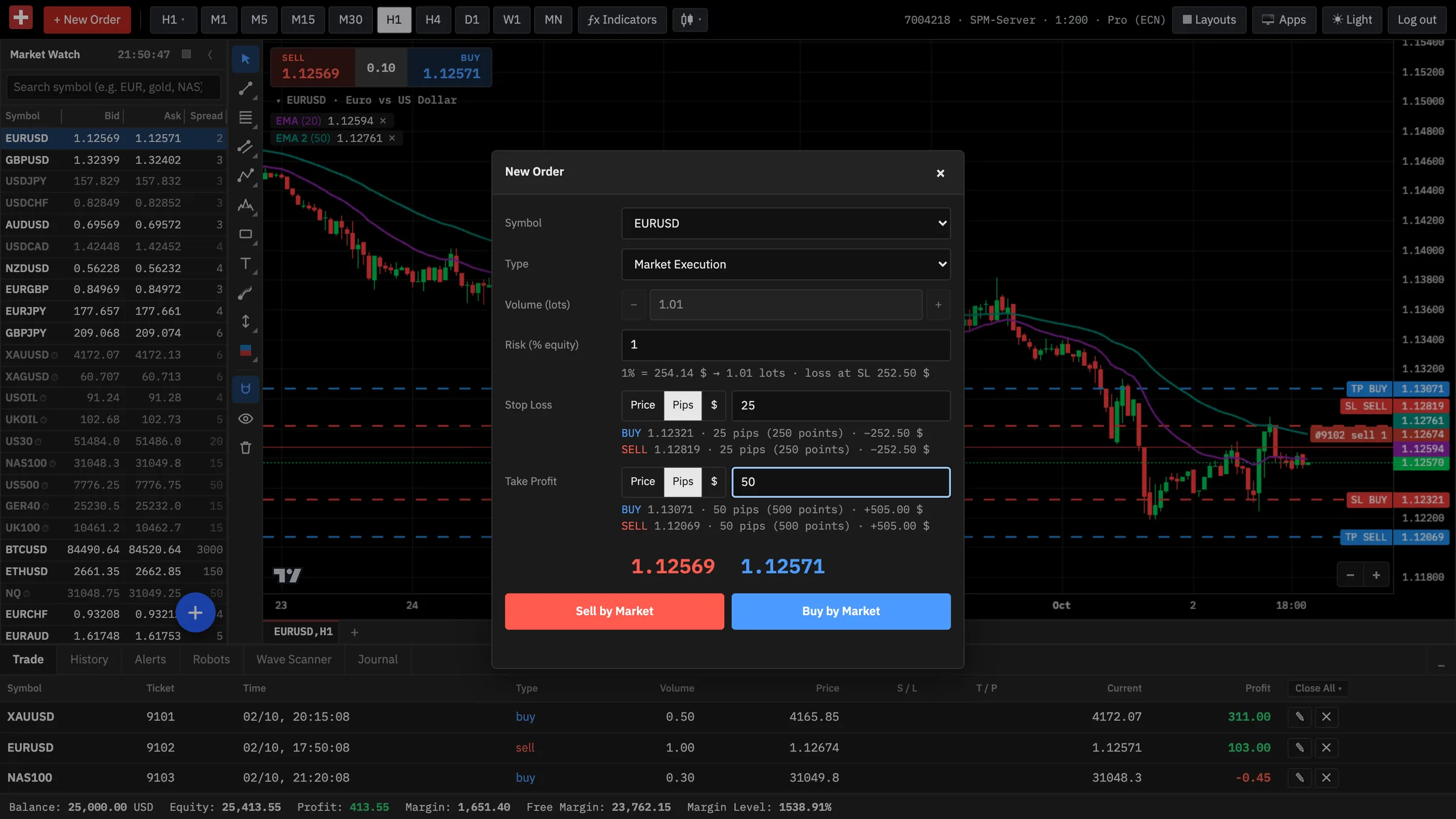
In the screenshot, 1% of equity is $254.14, so the account equity is about $25,414. With a 25-pip stop on EUR/USD, the formula gives $254.14 ÷ (25 × $10) = 1.0166 lots, and the ticket shows 1.01 lots, so the loss at the stop stays just under 1%.
The ticket does the arithmetic, but the decisions stay yours: where the stop goes and what percentage you risk. You can open a free demo account with up to $100,000 in virtual funds and size every practice trade this way until it becomes routine.
Key takeaways
- Risk a fixed 1% to 2% of equity per trade, and recalculate it before every trade.
- Place the stop where the idea is wrong, then size: lots = risk ÷ (stop in pips × pip value per lot).
- On JPY pairs, pip value per standard lot in USD = 100,000 × 0.01 ÷ USD/JPY rate.
- Ten losses in a row cost about 9.6% at 1% risk, but about 40% at 5% risk.
- Daily and weekly loss limits keep one bad day from doing lasting damage.
This lesson is general education, not investment advice. Examples use illustrative numbers. CFDs are complex instruments and come with a high risk of losing money rapidly due to leverage.